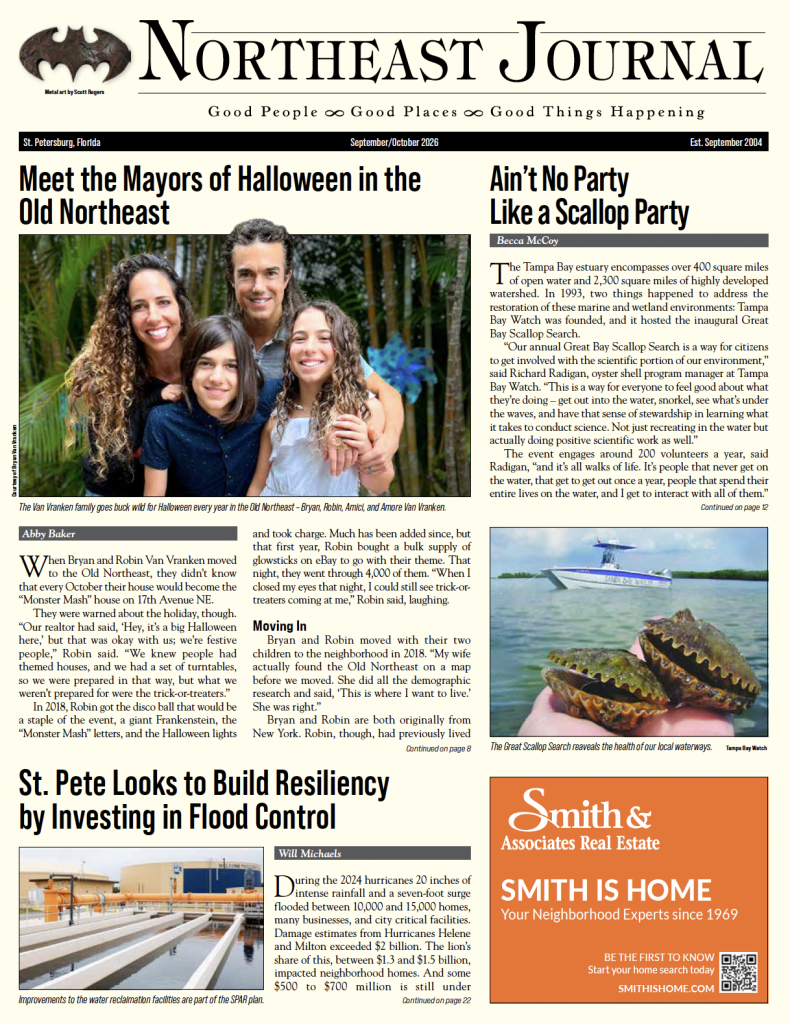
Ain’t No Party Like a Scallop Party: The Great Search Continues
The Tampa Bay estuary encompasses over 400 square miles of open water and 2,300 square miles of highly developed watershed. In1993, two things happened to address the restoration of these marine and wetland environments: Tampa Bay Watch was founded, and it hosted the inaugural Great Bay Scallop Search.
“Our annual Great Bay Scallop Search is a way for citizens to get involved with the scientific portion of our environment,” said Richard Radigan, oyster shell program manager at Tampa Bay Watch. “This is a way for everyone to feel good about what they’re doing – get out into the water, snorkel, see what’s under the waves, and have that sense of stewardship in learning what it takes to conduct science. Not just recreating in the water but actually doing positive scientific work as well.”
The event engages around 200 volunteers a year, said Radigan, “and it’s all walks of life. It’s people that never get on the water, that get to get out once a year, people that spend their entire lives on the water, and I get to interact with all of them.”
The 31st Annual Great Bay Scallop Search was scheduled for Saturday, August 1, 2026 – but the mercurial Florida weather had other plans.

“Logistically, the Scallop Search this year took place from Dunedin Causeway all the way down into Emerson Point Park,” said Radigan. “You have to look at all the weather for a large distance, and as you know, it can be really unpredictable.”
That unpredictability makes the decision to cancel or proceed a difficult one, but Radigan is surrounded by seasoned veterans that help inform a best path forward. “Working with Tampa Bay Estuary Program, as well as Pinellas County [Environmental Management] this year, there are so many years of field experience between all of our groups. Some of these people I’ve worked with for over 10 years. I’ve been in the field with them, so I trust their opinions.”
With safety concerns being paramount, the decision was made to pivot without sacrificing the initiative.
“We altered the format,” explained Radigan. “We took a single three-hour event where everybody gets together, and we extended it throughout the month of August.” Citizen scientists picked up their required equipment (a bucket with 50m weighted line and buoy, and PVC depth and width transect guides), downloaded the Survey123 app, and set out onto the waters on their own schedules to ensure this legacy data set logged another critical year. And generous support from manufacturing company Owens Corning meant the pivot didn’t have a negative financial impact on Tampa Bay Watch.

“Everybody’s been so incredibly understanding, which has been really refreshing. It’s really encouraging and inspirational that people care enough that they’re still getting out and doing the scallop search, said Radigan, adding, “it makes my job so much more fulfilling.”
At the time of writing, the window to participate in the search was still open and the data set was incomplete. But for Radigan, all data is useful data. “Zeroes are as much of a data point as 100 scallops,” he said. Early returns indicated another year of decline, which if confirmed by the complete data set, doesn’t necessarily spell doom and gloom… but it is a message.
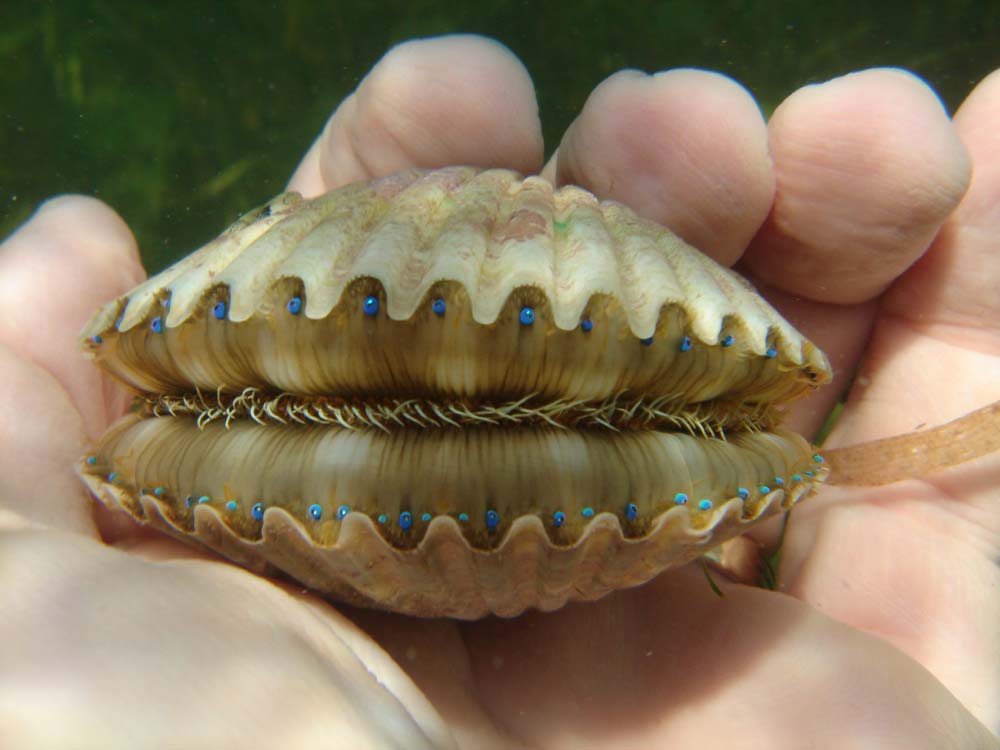
So, why do a scallop search? In terms of the search: looking for them is fun. Like an underwater Easter egg hunt – if the eggs were mobile, expelling water from between their halves to propel themselves and hide. And the community event aspect of the search promotes stewardship for the Bay, through which citizens personally invest in the care and wellbeing of the ecosystems.
But why scallops? They are an indicator species. They are very sensitive to water quality changes including rapid shifts in temperature, algal blooms, and minerals in the water. Scallops are filter-feeders, and an adult bay scallop can filter over 90 gallons of water a day. They need clear saltwater to flourish. They also require sea grass for their habitat, and restoring healthy sea grass beds continues to be an objective in parts of Tampa Bay. But there is more to the story of our Bay scallop numbers.

Scallops are a food source for animals such as sharks and rays whose population numbers have increased as their conservation efforts have proven successful. Even the scallop’s own life cycle creates obstacles for a robust resurgence. Their life span is approximately 12 months, which, while helpful for planning an annual event, is a narrow window for a creature to mature and spawn. A single scallop can spawn around 12 million eggs, but on average, only one will make it to adulthood. Not one million… just one.
Even with all the compounding factors, scallop trends are an important tool for assessing water conditions and shaping guidance. As Tampa Bay Watch Founder Peter Clark told The Gabber Newspaper at last year’s event, “It’s all a matter of dialing back the nutrients so that we have good water quality. Good light going through the water to the seagrass beds and getting those seagrasses to grow will continue to improve water quality. It’s a cycle, and you want to be on the good side of the cycle.”
Decades ago, scallops could be harvested in Tampa Bay. But by the 1960s, their population disappeared, likely due to overharvesting and degraded water conditions. Among the efforts that began in the 1990s to restore both the seagrass and the scallops, the Great Bay Scallop Search has become a cornerstone initiative for the organization.
“This is literally our longest running community monitoring program,” said Clark. Over the 30-year data set, the record high was in 2009 with 674 scallops found. And the record low was just four years earlier, when the search in 2005 identified one single scallop.

The scallop counts for the last 15 years have fluctuated but remain nominal for the size of the area being surveyed. The full story of the scallops and the watershed is comprised, not only of compounding factors in the water, but of complex land-based factors – many of which residents can control. Or, at least, influence.
“I think it’s really important for people who live throughout Pinellas County to understand that their actions, even in the center of the county, can have profound effects on our waters,” Radigan said. “These major weather events, which we take as our summertime storms, dump a lot of water – two to three inches of water – throughout a neighborhood. That’s hundreds of thousands of gallons of water that’s being washed into the Bay.” Stormwater runoff carrying fertilizer, automotive fluids, pet waste, lawn clippings, construction sediment, debris, and microplastics contaminates lakes, rivers, Tampa Bay, and eventually the Gulf of Mexico. And pollution in the water affects everything, from the aquatic ecosystem to our own health.
Tampa Bay Estuary Program’s website, tbep.org, shares several simple steps to make positive impacts. One of the most effective is cleaning up after our pets. There are an estimated half a million dogs living around the Tampa Bay watershed and they deposit 125 tons of waste on the ground every day. Pet waste in local bodies of water is an outsized contributor to disease-causing bacteria – and one of the easiest pollutants we can prevent.
They also branded “Be Floridian,” an initiative to promote native planting and remind residents to forego the fertilizer. You can also join them and other water-focused nonprofits at the 2026 Tampa Bay Debris Derby, scheduled for Saturday, September 26 – a gamifying of trash collection by land or by water with big prizes and a big sense of community pride.
Richard Radigan can’t wait to foster that sense of community at the next Annual Great Bay Scallop Search. “An event like this, I start planning on day-plus-one,” he said, smiling. Which means the 32nd Annual is already in the works. And weather permitting, in late summer 2027, Tampa Bay Watch will see you at 9 am on the beach.
In addition to the annual scallop search, there are a number of other volunteer events to get involved in helping the Bay. Visit tampabaywatch.org to learn more.